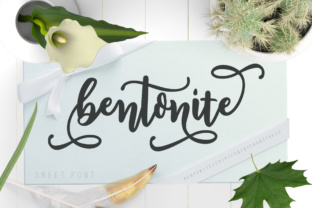
Bentonite Script: Crafting Elegance with a Modern Calligraphy Font
There’s a particular kind of design problem that calls for a personal touch—a project that needs to feel human, crafted, and intentional. Standard typefaces, as reliable as they are, sometimes fall short of conveying that warmth. This is where a font like Bentonite Script enters the conversation. It’s not just another script font; it’s a modern calligraphy font designed to bring a specific kind of sophisticated charm to your work. Its smooth, flowing lines and intentionally varying baseline create an organic rhythm that feels both classic and fresh, making it a powerful tool in any designer’s or creator’s toolkit.
At its core, Bentonite Script is a premium font that strikes a delicate balance. It possesses the fluidity of hand-lettering without the unpredictability. The visual characteristics are key to its appeal: the letterforms connect with a natural, graceful flow, and the baseline isn’t rigidly straight. This subtle movement mimics the way a skilled calligrapher’s hand might move across paper, giving your text a dynamic energy. The personality it projects is undeniably elegant, yet it avoids feeling stuffy or overly formal. It’s approachable sophistication, making it a versatile display font for projects that aim to connect on an emotional level.
Where Bentonite Script Truly Shines: Real-World Applications
Understanding a font’s strengths is one thing; knowing exactly where to deploy it is where the real skill lies. Bentonite Script excels in contexts where a personal, branded, or celebratory tone is desired. Think of it as the typographic equivalent of a firm, friendly handshake or a beautifully penned note. Its applications are wide-ranging, but its power is most evident in specific scenarios.
In logo design and brand identity work, this typeface can become the cornerstone of a brand’s voice. For a boutique bakery, a wedding planner, a high-end florist, or a personal coaching service, Bentonite Script immediately communicates care, quality, and a personal touch. It works beautifully as a primary logotype or as a complementary element paired with a clean sans serif font for body text. The contrast creates a professional and visually engaging visual hierarchy.
For editorial design and publishing, it’s a standout choice for chapter headings, pull quotes, or section dividers in magazines, lookbooks, and lifestyle blogs. It draws the reader’s eye and adds a layer of curated style to the layout. Similarly, in packaging design, especially for artisanal goods, cosmetics, or gourmet foods, Bentonite Script can elevate a product’s perceived value. A label featuring this font suggests craftsmanship and attention to detail before the customer even reads a word.
On the digital front, its use requires a bit more nuance. For web design, it’s rarely suited for long paragraphs of body copy due to its script nature. However, it’s incredibly effective for hero section headlines, call-to-action buttons (where brevity is key), or accent text in a sidebar. Its real strength online is in social media graphics. Instagram posts, Pinterest pins, and Facebook covers that feature Bentonite Script for key messages or quotes instantly stand out in a crowded feed, helping to build a recognizable and stylish brand presence.
The Practical Guide to Choosing and Using Bentonite Script
Adopting any new design asset requires thoughtful evaluation. Bentonite Script is a powerful tool, but it’s not a universal solution. The first step is always to assess the project’s fit. Ask yourself: does the project’s tone align with a handwritten, elegant aesthetic? A children’s toy brand might need something more playful, while a corporate law firm likely needs the authority of a serif font. For everything in between—creative entrepreneurs, event invitations, lifestyle brands—this font is often a perfect match.
One of the most critical skills in typography is mastering font pairing. A script font like Bentonite is rarely used in isolation. Its ornate nature demands a simpler counterpart to ensure readability and create a clear hierarchy. The classic pairing is with a geometric or humanist sans serif font. Fonts like Montserrat, Lato, or Open Sans provide a clean, modern canvas that allows the script to be the star without causing visual chaos. You could also pair it with a sturdy serif font for a more traditional, editorial feel. The key is contrast in style, not just in weight.
Before finalizing your choice, take time to review the font’s included styles and characters. A quality commercial font like this often comes with alternates, ligatures, and swashes. These are different versions of letters (like a fancier capital 'B' or 'S') that can be swapped in to add even more uniqueness to your design. Testing these in your specific layout can make a significant difference in the final polish. Always check the commercial licensing terms as well to ensure your intended use—whether for a client project, merchandise, or a website—is fully covered.
Finally, prioritize readability above all else. The most beautiful font fails if its message can’t be deciphered. Use Bentonite Script for headlines, short phrases, and accents where its intricate details can be appreciated at a glance. Avoid using it for small, lengthy text blocks. Test your designs at the intended size and on the intended medium—what looks stunning on a large print poster may become a blurry line on a mobile screen. By applying it thoughtfully, you harness its ability to enhance brand perception, create recognition, and foster genuine audience engagement. It’s not about following a trend, but about choosing a creative font that authentically amplifies your project’s voice.