Salita Script: Adding Handwritten Charm to Your Brand
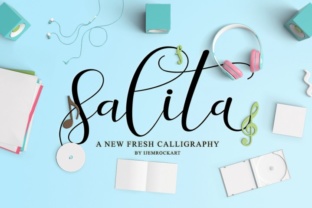
There’s a specific feeling you get when you see a typeface that actually looks like it was written by a human hand, not just designed by a vector pen tool. That’s the immediate impression with Salita Script. Created by IjemRockArt, this font family captures the essence of casual elegance. It walks that fine line between being a polished premium font and maintaining that raw, handwritten font energy. For anyone working in brand identity, editorial design, or packaging design, finding a typeface that feels personal without looking messy is a constant struggle. Salita Script solves that problem by offering a fluid, natural baseline and letterforms that mimic the pressure and rhythm of a real pen.
Visually, the typeface is characterized by its flowing connections and balanced proportions. It doesn’t try too hard to be eccentric; instead, it focuses on legibility and warmth. The strokes have a natural variation in thickness, which adds depth to the text, preventing it from looking flat on a screen or a printed page. It’s the kind of script font that feels trustworthy. Whether you are a blogger trying to make a header stand out or a small business owner designing a logo, the visual personality of Salita Script suggests approachability and creativity. It feels like a friendly note passed across a coffee shop table, making it an excellent tool for building a connection with your audience.
The Anatomy of a Versatile Creative Asset
When we talk about the "anatomy" of a font like this, we aren't just looking at the curves of the 'g' or the crossbar of the 't'. We are looking at how those shapes behave in different environments. Salita Script is designed with modern usage in mind. It works beautifully as a display font for headlines, but it holds up surprisingly well in short-form body copy if the size is generous. This versatility is crucial for content creators who need a consistent look across multiple platforms. You might be using it for an Instagram story today and a printed workshop flyer tomorrow. The font maintains its integrity across these mediums, which is a hallmark of modern typography.
The style leans towards a modern calligraphy aesthetic, but it avoids the overused swashes that make other script fonts illegible. This makes it a strong contender for web design headers. We’ve all seen websites where the fancy font takes five seconds to read because the loops are too tight. Salita Script prioritizes the reader's eye. The spacing (kerning) is generally well-balanced, allowing the letters to breathe. For entrepreneurs and marketers, this means you don’t have to spend hours manually adjusting the tracking in Adobe Illustrator just to make the headline readable. It’s ready to go, right out of the box, saving you valuable production time.
Strategic Applications: From Packaging to Pixels
Let’s get practical. Where does Salita Script actually earn its keep? If you are in the crafting or Etsy space, this font is a goldmine for packaging design. Imagine this typeface on a kraft paper label for artisanal honey or a boutique candle. The handwritten aesthetic immediately signals "small batch" and "handmade," even if you are printing thousands of units. It bridges the gap between the product and the consumer, adding a perceived value to the item.
For designers and publishers, the application extends to editorial design. Think of magazine pull quotes or chapter titles in a lifestyle book. Using Salita Script here breaks the monotony of standard serif fonts or sans serif fonts. It creates a visual hierarchy that guides the reader's eye to the most important parts of the page. It says, "Pay attention to this; this is the opinion, the heart, or the key takeaway."
In the digital realm, social media graphics are often the first point of contact for a brand. Static, corporate-looking text often gets scrolled past. A font like Salita Script adds personality to a quote card or a sale announcement. It feels native to the platform—organic and personal. However, it is essential to use it as an accent. If you pair it with a clean, geometric sans serif font for your body text, you create a professional contrast that looks high-end. This is the secret sauce of good font pairing: using the script for impact and the sans serif for information.
Refining Your Workflow with Salita Script
Choosing a font is a subjective decision, but choosing a commercial font is a business decision. When evaluating Salita Script for a project, the first step is to test it against your specific brand voice. Does the font feel too playful for a serious consultancy? Or is it the perfect way to humanize a corporate brand? Look at the included styles. Does the family come with alternates or ligatures? These features are vital for logo design. You want to be able to swap out a letter that might look awkward in a specific combination to ensure the logo flows seamlessly.
Readability is the non-negotiable factor. A beautiful font that people can't read is a failed design. Test Salita Script at the size you intend to use it. Check the legibility of tricky letter combinations like "bl," "br," or "ol." Because it is a connected script, ensure the connections don’t create visual clutter at smaller sizes. For web design, remember that script fonts generally require more leading (line height) than standard text to avoid ascenders and descenders crashing into each other.
Finally, consider the licensing. As a creative professional, you need to ensure your design assets are legally covered for your client's use, whether that’s for a global ad campaign or a local flyer. Salita Script is a tool, and like any good tool, it works best when you understand its capabilities and its limits. It won’t replace your workhorse body text font, but it will elevate your headlines, logos, and marketing materials from generic to memorable. By integrating this typeface into your toolkit, you are investing in a type of visual storytelling that feels distinctly human in an increasingly digital world.